Finally, A Quick Guide To
Investment Property Mortgages
Have you ever tried to get details on residential investment property mortgages?
Let me tell you, it's a real adventure.
Your local Canadian bank branch usually doesn't have a clue and ends up scaring you off from doing any residential real estate investing altogether.
There are some excellent people in bank branches, you just need to find them.
Basically, bank branches aren't set up to deal with the questions investors have, and they work on residential investment property mortgages so infrequently they usually don't know the details.
An experienced mortgage broker will usually serve you better in this area.
Some banks don't deal with mortgage brokers. BMO isn't using them right now, and RBC has their own team of mobile mortgage representatives.
I have experience with the Royal Bank ones, and they have proven to be very good.
One thing to note that when you are dealing with a bank directly, you are limited to the mortgage products that they offer and sometimes you won't even know other, better suited, options are available to you.
For example, there is a 5% down investment property mortgage program available to Canadians right now. (UPDATE: Times have changed yet again, for the latest Canadian Investment Property Mortgage updated check out this blog post). If your bank is not offering the program, they may not even tell you that this exists elsewhere.
So if you are using BMO or RBC directly, or for that matter, if you are using any bank directly for your mortgage, it's smart to check in with an experienced mortgage broker as well.
That way you've covered almost all of the options available to you.
I say "almost" because there are private institutions that will lend you money (Xceed Financial) and "hard money" lenders. We'll discuss this in more detail in a future article.
Know this...they are constantly changing, and there are new mortgages for investment properties coming available almost monthly!
So again, an experienced mortgage broker is likely your best answer. When buying an investment property, you are likely looking to put as little down as possible to gain maximum leverage.
---------- When you put less than 20% down on a residential property in Canada you are using what is referred to as a "high ratio" mortgage.
---------- So single-family homes up to four-plexes. Anything greater is usually classified as a commercial property, and the mortgage qualifications are very different. More on this in another article. Whenever you put less than a 20% down payment the banks, use "mortgage insurers" to insure the mortgage because of the perceived higher risk that you might default on the mortgage payments.
The largest mortgage insurer in Canada is CMHC, The
Canadian Mortgage and Housing Corporation.
Genworth Canada is another mortgage insurer and is the largest private sector supplier of mortgage insurance.
Now, here's where things get interesting.
CMHC has dominated the Canadian market for mortgage insurance since I was sucking on a baby bottle.
Well, over the last few years Genworth, in what I believe must be an attempt to get more market share, has aggressively been offering fantastic new mortgage insurance programs.
One of the best was introduced in 2007. It was a 10% down payment mortgage program for investment property mortgages. Before this, you had to put 15%, and some banks would tell you that you needed to put 25% or even 35% down, pretty nutty.
Well, the lack of mortgage insurance competition here in Canada has finally attracted some U.S. insurers.
And now AIG has entered the market and PMI, and one other U.S. based insurer, have plans to enter into Canada as well.
All the money that CMHC has been making has finally attracted some other players.
And this leads us to our next point...
As mentioned above, until 2007 you really got a lot of strange answers when asking banks and brokers about investment property mortgages.
My first experiences, years ago, were down right confusing. I remember sitting in a branch of one of the big banks feeling like I had to pull teeth to get any answers.
I was being told I had to put down 25% for investment property mortgages. And then a few days later I was informed they made some changes and I may actually have to put down 35%.
Today, it's much better, although you're still in somewhat uncharted waters unless you have someone with experience working with you.
Here's a summary of the investment property mortgage scene.
----------
If you choose to use a 20% down payment for investment property mortgages the world is your oyster. Most financial institutions will bend over backwards to get your business.
You are considered very low risk to default on the mortgage.
You'll still need a good credit score and the income necessary to qualify for the mortgage, but overall, you are in good shape to shop for a mortgage anywhere you please.
You should be able to get the most attractive interest rates available, whether you choose to go with a fixed rate or a variable rate.
You should also be able to negotiate an 'open mortgage' which means that there is no mortgage penalty (often 3 months worth of interest) if you sell the house and pay off the mortgage early.
If you aren't able to negotiate an open mortgage then ask if your mortgage is "portable". If it is you may be able to move this mortgage into another investment property with no penalty or reduced penalties.
And you should be able to avoid having to purchase mortgage insurance all together.
Each bank and/or credit union differs on this point but with some minimal effort and negotiation you should be able to avoid investment properties mortgage insurance.
These are the details that an experienced mortgage broker can help you with.
Onto the fun stuff...
Now things get interesting.
In 2007 Genworth Financial began insuring investment property mortgages with 10% down payments.
This was huge. Until this was announced you were stuck with 15% as the lowest down payment you could use.
I believe this may have been announced as a great way to attract more mortgage business from the large Canadian banks.
Also, it was announced at a time when there were rumblings that AIG (a U.S. mortgage insurer) was going to enter the Canadian market with similar offerings.
Competition is good!
This is a great program that finally introduced a way to purchase residential real estate (up to four units) with a 10% down payment.
There are a few details that your mortgage broker or banker should cover with you. One is that the insurance premium on this program is higher than for mortgages on a primary place of residence (a mortgage on a home that you live in).
Depending on your tax planning expertise, and, which real estate investment strategy you use, the higher premium shouldn't be a show stopper for you. If you want more info on the tax planning talk to a financial planner or your accountant.
Overall, this 10% program is a major step forward in financing investment property mortgages. Fantastic news for all of us investors.
With Genworth Financial's 10% program and CMHC's 5% program these really are the golden years of residential investment property mortgages in Canada.
But there are other options...
If you really want to get aggressive you can turn to "hard money" lenders. These are basically mortgage brokers or other professionals who have access to individuals willing to lend you money.
There are still qualifications to meet but they may be less stringent. You'll pay for this privelege though, typical hard money loans have interest rates of 12% or higher with finder fees tacked on to them as well.
Venture into "hard money" investment property mortgages with caution and work with an experienced real estate investor/coach/mentor only.
And there are private institutions like Xceed Financial that have offered 5% down mortgages in the past for investors without perfect credit. With recent changes in the financial industry these may vanish soon.
However, for these types of investment property mortgages you will require high enough income, a good to great credit score and you will likely jump through a few extra qualification hoops.
Canadian investment property mortgages have had recent changes around amortization periods.
Until 2006 almost all your options involved using a 25-year amortization period or less.
Today, we can get amortization periods on investment property mortgages all the way up to 35-year amortizations.
There are a couple of driving forces behind these changes. With home prices increasing across Canada rapidly, longer appreciations allow for lower monthly payment and therefore more people can qualify for home ownership.
Getting people into their own homes is one of the main reasons for the existence of mortgage insurers like CMHC.
Some recent studies (that I can't recall the source of right now) reported that younger Canadian families are more interested in 'lifestyle' than 'paying off their mortgage'.
So with lower monthly payments a result of longer amortization periods the mortgage insurers are giving the public what it's looking for apparently.
Longer amortization periods also mean that you are paying much more interest on your mortgage thoughout it's life.
That is, each of your mortgage payments have a higher portion of it going to interest instead of the principle portion of the mortgage.
For the home that you are purchasing to live in this may not be the best situation.
But, for investors, long amortization periods on investment property mortgages have two main advantages:

Canadian Banks & Mortgage Brokers
"So, What Should I Know About
Investment Property Mortgages?"
Invesment Property Mortgages
Some Background for Context
ASIDE: Now, be aware that when you do this if your property value falls you could have a mortgage amount that is more than the value of your property. You really want to work with a mentor or coach who can offer some experience and guidance. If you want to reach out to us for this
click here to read about one of our favourite strategies and to get more information.
----------
ASIDE: A property is "usually" classified as 'residential' if it has up to four living units.
----------
Investment Property Mortgages
-- The Mortgage Programs --
ASIDE: Remember, the products and programs are constantly changing, so to get the most current information work with an experienced broker or banker.
----------
-- 20% Down Payments --
Investment Property Mortgages-- 10% Down Payments --
Investment Property Mortgages"What Are My Other Options?"
-- Amortization Periods --
Investment Property Mortgages
Out of everything discussed around investment property mortgages, amortization periods get the most animated response from people.
So if you are not sure what choices you should be making find an experienced coach or mentor and bounce your questions off them.
"What Else Should I Know?"
There are details, fine print and exceptions to almost everything.
Things like mortgage penalties, mortgage insurance rates and mortgage terms need to be addressed.
So you will need to do your homework and make sure the investment property mortgages you use are right for you.
Ask questions, don't be scared.
If what the bank or mortgage broker is offering you is confusing, get clarification.
Click here for a detailed guide to the types of investment real estate loans used by Canadians!
Return from Investment Property Mortgages to the Real Estate Investment Guide by clicking here.
Some Cool Free Stuff...
Step 1:
|
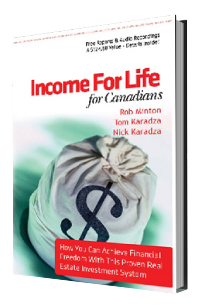
Grab a free digital copy of our real estate investing book, Income For Life For Canadians, right here. This book has been downloaded over 22,597 times and has helped hundreds of investors kick-start their investing with simple and straight forward strategies that you can implement right here in Canada. |
 |
|
You'll also receive our weekly [Your Life. Your Terms.] email newsletter with the latest investing updates and videos. |
Step 2:
|
Free Weekly Investing Videos & Articles: Get the latest updates and join the over 10,000 other Canadians enjoying the weekly [Your Life. Your Terms.] email newsletter. The email is sent out each Thursday. And as a little bonus we'll give a FREE digital copy of the book, Income For Life For Canadians, too! |
Your Life. Your Terms.
Step 3:
|
Free LIVE Investing Class: Do you live in the Greater Toronto or Golden Horseshoe Area? Come out to our next introductory "Investing in Nice Homes in Nice Areas" Real Estate Class. |
 |
|
It's 90-minutes and you'll learn a ton - promise!Thousands of investors have now joined us for this class and the feedback has always been amazing. |