What happens if things go bad?
by Steve DeVoe
(Mississauga, Ontario, Canada)
After reading your book I'm more intrigued than ever. But I'm curious, particularly since a lot of this comes from the U.S., what happens if/when the market makes a correction.
I can't help but envision owning x number of homes, the market drops by 10% or more(if we are in a bubble not an outlandish possibility)and all your rent to own tenants realize the house is worth substantially less then they have it optioned for. They no longer are willing to pay a higher rent since they know they likely are not buying the house at the agreed price any longer. Further, it seems conceivable to me that if they know they are going to loose their deposit anyway if they opt not to buy at an over market price at the end of the lease they will just walk away.
Is it not a possibility that in a down turn (Similar to the U.S. today) that you could end up with a substantial part of ones portfolio vacant and thus a real problem with cash flow to cover the mortgage payments?
What has happened to your U.S. members where the values have dropped by huge percentages?
Comments for What happens if things go bad?
|
||
|
||
|
||
Some Cool Free Stuff...
Step 1:
|
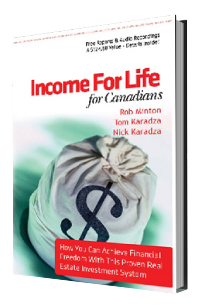
Grab a free digital copy of our real estate investing book, Income For Life For Canadians, right here. This book has been downloaded over 22,597 times and has helped hundreds of investors kick-start their investing with simple and straight forward strategies that you can implement right here in Canada. |
 |
|
You'll also receive our weekly [Your Life. Your Terms.] email newsletter with the latest investing updates and videos. |
Step 2:
|
Free Weekly Investing Videos & Articles: Get the latest updates and join the over 10,000 other Canadians enjoying the weekly [Your Life. Your Terms.] email newsletter. The email is sent out each Thursday. And as a little bonus we'll give a FREE digital copy of the book, Income For Life For Canadians, too! |
Your Life. Your Terms.
Step 3:
|
Free LIVE Investing Class: Do you live in the Greater Toronto or Golden Horseshoe Area? Come out to our next introductory "Investing in Nice Homes in Nice Areas" Real Estate Class. |
 |
|
It's 90-minutes and you'll learn a ton - promise!Thousands of investors have now joined us for this class and the feedback has always been amazing. |

This book has been downloaded over 22,597 times and has helped hundreds of investors kick-start their investing with simple and straight forward strategies that you can implement right here in Canada.